If you’ve ever installed a new set of composite brake discs, you’ve probably heard a mix of conflicting advice about “breaking them in.” Some say slam on the brakes cold; others warn against high speeds for the first few hundred miles. As a composite brake discs supplier, I’ve seen firsthand what happens when the break-in process is rushed—and what goes right when it’s done properly. This isn’t just a subjective tip; it’s a science-backed step that protects your investment, extends disc life, and ensures consistent performance. Let’s break down why composite brake discs need a specific break-in routine, the risks of skipping it, and the exact process to follow. Composite Brake Discs
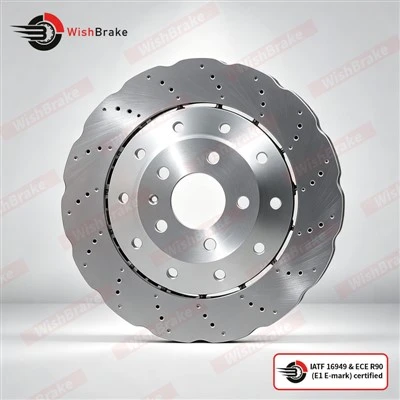
First, it’s important to understand what makes composite brake discs different from their cast iron counterparts. Unlike solid cast iron, composite discs are layered: a high-carbon ceramic or carbon-fiber reinforced silicon carbide (C/SiC) friction surface is bonded to a lightweight aluminum core. This design delivers better heat resistance, longer wear life, and reduced unsprung weight—all of which are huge benefits for performance vehicles, race cars, and even heavy-duty commercial trucks. But that layered structure also means the surface isn’t perfectly smooth right out of the box. Factory machining leaves micro-scale irregularities: tiny bumps, tool marks, and residual dust from manufacturing. If you don’t smooth those irregularities gradually, you’ll get uneven contact between the disc and your brake pads. That leads to hot spots, premature pad wear, and even cracking in extreme cases.
I learned this lesson early in my first year as a supplier. Back then, a customer brought back a set of composite discs that had cracked after just 500 miles of track use. They’d skipped break-in and immediately lapped the car at 150+ mph, repeatedly hard braking from 120 mph to 0. The sudden heat spike caused the outer ceramic layer to expand faster than the inner aluminum core, creating internal stress that led to the cracks. We later examined a sample of their pads, and found they’d worn unevenly: one edge of each pad was thin, while the other was still thick, a direct result of poor initial contact. That experience taught me that break-in isn’t a “nice-to-have” — it’s a critical step that aligns the friction surfaces of your discs and pads, preventing avoidable damage.
So what’s the right way to break in composite brake discs? The process is designed in three distinct stages, each with specific speed, brake pressure, and temperature rules to follow. Rushing any stage will undermine the results, and skipping the cooling periods is one of the most common mistakes.
The first stage is called “Initial Smoothing,” and it’s all about low-stress, gradual contact. You’ll want to start on a road that’s empty, where you can safely accelerate to moderate speeds, then brake gently without triggering antilock brakes (ABS). Here’s the step-by-step for this stage: Accelerate your vehicle to 30 to 40 mph (no faster) on a flat, straight stretch. Apply firm but smooth brake pressure—enough to slow you to 15 to 20 mph over 5 to 8 seconds. Repeat this 10 times, with at least 3 minutes of cool-down between each stop. The cool-down is non-negotiable here: during braking, the disc surface heats up to around 150 to 200°F. If you brake again before it cools, you’ll overheat the micro-irregularities instead of smoothing them evenly. Avoid any hard stops, hills, or high-speed driving in this stage—your goal is to create a uniform layer of transfer film from the brake pad to the disc surface, not to test performance.
The second stage is “Heat Cycling,” which builds on the initial smoothing to create a durable transfer layer. This layer is key: it’s a thin, even coating of pad material that bonds to the disc, eliminating any gaps between the disc and pad. For composite discs, this transfer film is more important than on cast iron, because it’s what creates consistent friction. If the film is uneven, you’ll get inconsistent brake feel and uneven wear. For this stage, you’ll move to slightly higher speeds, but still avoid extreme heat. Accelerate to 50 to 60 mph, then apply moderate brake pressure to slow to 20 mph in 10 to 12 seconds. Do this 8 times, with a 4-minute cool-down between each stop. During these stops, the disc will heat up to around 300 to 350°F—safe for the composite structure, but high enough to melt the pad material slightly and form a uniform transfer layer. Still no hard braking, no track days, no towing heavy loads. This stage is where you’ll start to notice a subtle change in brake feel: the pedal will feel firmer, more consistent, as the transfer layer sets in.
The third and final stage is “Performance Finishing,” which preps the discs for regular use. This is where you can introduce moderate braking that’s closer to what you’d experience in daily driving or even light track sessions, but you still need to avoid extreme heat spikes. Accelerate to 60 to 70 mph, then apply firm brake pressure to slow to 25 mph in 12 to 15 seconds. Repeat this 6 times, with a 5-minute cool-down between each stop. By the end of this stage, the disc surface will be fully smoothed, and the transfer layer will be intact. You’ll have around 100 miles on the odometer at this point, and your composite discs are now ready for full use—whether that’s commuting, track days, or heavy-duty hauling.
Now, let’s talk about common mistakes that can ruin your composite discs during break-in. The first is “cold hard braking”: slamming on the brakes from high speeds right out of the gate. As I mentioned earlier, this causes uneven thermal expansion of the layered disc, leading to cracking or warping. Another mistake is skipping the cool-down periods. Even if you think your brakes feel fine after a stop, the disc is still holding heat that can damage the bond between the friction surface and core if you hit them again too soon. A third mistake is using the wrong pads during break-in. Low-metallic or semi-metallic pads work well for composite discs, but avoid organic pads for the first 100 miles—they tend to create a thin, inconsistent transfer layer that wears off quickly. Our team tests all composite disc kits with a recommended pad spec, and we always note that in the packaging to help customers avoid this mistake.
I also get asked a lot about break-in for heavy-duty commercial composite discs, which is a bit different. For commercial trucks, the process is slightly longer: 12 initial stops at 30 mph, 10 heat cycles at 50 mph, and 8 performance stops at 60 mph, with longer cool-down periods (4 minutes between initial stops, 6 between heat cycles). The reason is that commercial vehicles carry heavier loads, so the initial contact needs to be more gradual to prevent uneven wear under stress. We’ve worked with several fleet operators who followed this tailored process, and they reported 15% longer disc life compared to those who skipped break-in.
Another point to highlight: composite discs can be sensitive to exposure to moisture during break-in. If it rains while you’re in the middle of the process, stop and wait for the discs to dry completely before continuing. Water on a heated disc can cause thermal shock, which can crack the ceramic surface. I’ve seen this happen to a customer who tried to drive through a rainstorm mid-break-in; their discs developed tiny surface cracks that would have been avoided if they’d waited.
Once you’ve completed the break-in, how do you maintain your composite discs to keep them performing? The transfer layer is fragile for the first few hundred miles, so avoid washing your brakes with high-pressure water for at least 50 miles after break-in. High pressure can strip the transfer layer, leading to inconsistent braking. Also, avoid using harsh brake cleaners on new discs—stick to a mild, pH-neutral wheel cleaner to keep your wheels clean without damaging the friction surface.
As a composite brake discs supplier, our goal isn’t just to send out a high-quality product—it’s to help customers get the most out of it. That’s why we include a detailed break-in guide with every set of discs we ship, and our support team is always available to answer questions. Whether you’re a performance enthusiast building a track car, a fleet manager upgrading your delivery trucks, or a driver looking for long-lasting brake components, proper break-in is the first step to reliable, consistent performance.
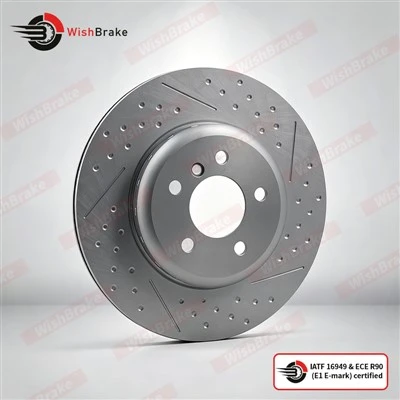
If you’re looking for high-quality composite brake discs, from lightweight C/SiC for performance vehicles to heavy-duty reinforced options for commercial trucks, we can help you find the right fit for your needs. Contact us to discuss your requirements and get more information on our products.
Brake Rotors for BMW References
- Carbon-Carbon and Carbon-Silicon Carbide Composite Materials for High-Performance Braking, Journal of Composite Materials, 2018
- Thermal Fatigue Behavior of Composite Brake Discs, Wear, 2020
- Brake Pad Transfer Films: Formation and Effects on Friction Performance, SAE International Journal of Passenger Cars – Mechanical Systems, 2019
- Heavy-Duty Brake System Optimization: The Role of Composite Components, International Journal of Heavy Vehicle Systems, 2021
- Guidelines for Surface Preparation and Break-In of Ceramic Composite Brake Components, Society of Automotive Engineers (SAE) Technical Paper, 2020
Qingdao Wish Auto Parts Co., Ltd.
Qingdao Wish Auto Parts Co., Ltd. is one of the most professional composite brake discs manufacturers and suppliers in China. We are committed to providing high quality customized automotive brake discs with competitive price. Welcome to wholesale CE approved composite brake discs in stock here and get quotation from our factory. 1 year warranty is available.
Address: No.45 Pengwan Road, Qingdao, Shandong Province, China
E-mail: SALES@wishbrake.com
WebSite: https://www.wishbrakeparts.com/
